 KHS


Articles
- Page Path
- HOME > Headache Pain Res > Volume 27(3); 2026 > Article
-
Original Article
Preliminary Quantitative Electroencephalographic Evidence of Depression-Aligned Neurophysiological Patterns in Interictal Migraine: A Multi-Dataset Study -
Dokyung Lee

-
Headache and Pain Research 2026;27(3):221-230.
DOI: https://doi.org/10.62087/hpr.2026.0022
Published online: October 30, 2026
Department of Neurology, Seongnam Chung Hospital, Seongnam, Republic of Korea
- Correspondence: Dokyung Lee, M.D., Ph.D. Department of Neurology, Seongnam Chung Hospital, 76 Sujeong-ro, Sujeong-gu, Seongnam 13316, Republic of Korea Tel: +82-31-750-6000, E-mail: dkja111@gmail.com
© 2026 The Korean Headache Society
This is an Open Access article distributed under the terms of the Creative Commons Attribution Non-Commercial License (https://creativecommons.org/licenses/by-nc/4.0) which permits unrestricted non-commercial use, distribution, and reproduction in any medium, provided the original work is properly cited.
- 260 Views
- 4 Download


Abstract
-
Purpose
- This study aimed to examine whether interictal migraine shows neurophysiological patterns aligned with an external major depressive disorder (MDD) reference dataset, using quantitative electroencephalography (qEEG) indices less sensitive to absolute amplifier gain.
-
Methods
- Three datasets were analyzed: ds005385 (normative reference, n=608; age-matched subset, 45–70 years, n=309), TDBRAIN (MDD, n=120; insomnia, n=30; healthy controls, n=47), and 25 patients with interictal migraine (chronic migraine, n=7; episodic migraine, n=18; mean age, 60.0 years; female, n=17). Eight candidate qEEG indices were ranked by effect size in TDBRAIN; the aperiodic exponent and frontal-parietal low-beta asymmetry (FP_asym_LowBeta) showed the largest effects and were selected for analysis. Four arousal-state windows were evaluated: eyes-closed resting, hyperventilation, post-hyperventilation 120 seconds, and post-hyperventilation 300 seconds.
-
Results
- In TDBRAIN, patients with MDD showed a reduced aperiodic exponent (Cohen's d=–0.63, p=0.001) and elevated FP_asym_LowBeta (Cohen's d=+0.83, p<0.001) versus healthy controls. In migraine, FP_asym_LowBeta was significantly elevated versus the age-matched normative reference after false discovery rate (FDR) correction during hyperventilation (p=0.015), post-hyperventilation 120 seconds (p=0.004), and post-hyperventilation 300 seconds (p=0.003); the eyes-closed resting window showed a nonsignificant trend (p=0.058). Compared with episodic migraine, chronic migraine showed a consistent but exploratory trend toward a lower aperiodic exponent across windows (Cohen's d=-0.95 to -1.12, using sample-size-weighted pooled standard deviations), though no comparison survived FDR correction. A linear mixed-effects model showed no significant main effect of migraine subtype (p=0.084).
-
Conclusion
- Interictal migraine showed preliminary qEEG patterns aligned with those observed in an external MDD reference dataset, particularly in frontal-parietal low-beta asymmetry during hyperventilation and recovery. However, these exploratory findings require validation in larger, age-matched cohorts with appropriate control for medication use and mood-related confounders.
INTRODUCTION
MATERIALS AND METHODS
1) Aperiodic exponent
2) FP_asym_LowBeta
RESULTS
DISCUSSION
AVAILABILITY OF DATA AND MATERIAL
The data presented in this study are available upon reasonable request from the corresponding author.
AUTHOR CONTRIBUTIONS
Conceptualization: DL; Data curation: DL; Formal analysis: DL; Investigation: DL; Methodology: DL; Writing–original draft: DL; Writing–review & editing: DL.
CONFLICT OF INTEREST
No potential conflict of interest relevant to this article was reported.
FUNDING STATEMENT
None.
ACKNOWLEDGMENTS
This manuscript was prepared with the assistance of Claude (Anthropic, claude-sonnet-4-6) in May-June 2026, utilized solely for English language editing and Python coding suggestions. All statistical analyses, data interpretation, clinical judgment, and final verification were performed independently by the author.


| Dataset | Participant (n) | Age (yr), mean (range) | Role/Description |
|---|---|---|---|
| ds005385 | 608 | 44.1 (20–70) | Part of the Dortmund Vital Study7; prospective resting-state EEG dataset for cognitive aging research; BIDS format; OpenNeuro. Age-matched subset 45–70 years (n=317) used for normative comparison; final n=309 after IQR×3 outlier removal. |
| TDBRAIN | 241 (subset) | 40.8 (17–78) | Two Decades-Brainclinics Research Archive for Insights in Neurophysiology.8 Original database: 1,274 participants (2001–2021). Publicly available subset used (OpenNeuro; n=241). Analyzed groups: MDD n=120 (after outlier removal), insomnia n=30, healthy controls n=47 (total n=197 analyzed). OCD (n=37) and burnout (n=6) excluded as not relevant to the depression-normative comparison framework. |
| Migraine patients (present study) | 25 | 60.0 (45–68) | Interictal migraine patients (ICHD-3); chronic migraine n=7, episodic migraine n=18; female n=17 (68%). EEG performed at least 48 hours after most recent headache attack. 2 data points removed as outliers (IQR×3). |
| Characteristic | Total (n=25) | Chronic migraine (n=7) | Episodic migraine (n=18) |
|---|---|---|---|
| Demographics | |||
| Age (yr) | 62.0 (55.0–65.0) | 63.0 (56.5–66.0) | 62.0 (55.0–65.0) |
| Female sex | 17 (68) | 5 (71) | 12 (67) |
| Headache characteristics | |||
| Disease duration (yr) | 3.0 (2.0–5.0) | 5.0 (4.0–5.0) | 3.0 (1.0–5.0) |
| Monthly headache days | 10.0 (7.0–20.0) | 25.0 (25.0–30.0)* | 8.0 (5.0–10.0) |
| Monthly migraine days | 3.0 (2.0–10.0) | 10.0 (10.0–10.0)* | 2.0 (1.0–3.0) |
| Aura | 4 (16) | 2 (29) | 2 (11) |
| MOH | 6 (24) | 6 (86)* | 0 (0) |
| Acute medication | |||
| Triptans | 8 (32) | 3 (43) | 5 (28) |
| NSAIDs | 14 (56) | 3 (43) | 11 (61) |
| Preventive medication | |||
| Topiramate | 13 (52) | 5 (71) | 8 (44) |
| Valproate | 16 (64) | 5 (71) | 11 (61) |
| CGRP-targeted therapies | 4 (16) | 3 (43) | 1 (6) |
| Concomitant medications | |||
| SSRI | 14 (56) | 6 (86) | 8 (44) |
| Benzodiazepine | 11 (44) | 3 (43) | 8 (44) |
Values are median (interquartile range) or number (%).
MOH, medication overuse headache (International Classification of Headache Disorders, 3rd edition criteria); NSAIDs, non-steroidal anti-inflammatory drugs; CGRP, calcitonin gene-related peptide; SSRI, selective serotonin reuptake inhibitor.
*p<0.001 versus episodic migraine (Fisher exact or Mann-Whitney U-test).
Values are mean±standard deviation (post-outlier removal) unless otherwise stated. p-values from Mann-Whitney U-test.
qEEG, quantitative electroencephalography; TDBRAIN, Two Decades-Brainclinics Research Archive for Insights in Neurophysiology; MDD, major depressive disorder; FP_asym_LowBeta, frontal-parietal low-beta asymmetry; FP_asym_Beta, broadband beta variant; IAF, individual alpha frequency; fooof_TAR, FOOOF-corrected theta/alpha ratio; FAA, frontal alpha asymmetry; TBR, theta/beta ratio; ns, not significant.
Values are mean±standard deviation (post-outlier removal). Chronic migraine n=7; HVT n=6 (one outlier-removed data point). All comparisons are considered exploratory given the small chronic migraine subgroup (n=7). *Uncorrected p<0.05 (did not survive FDR correction).
qEEG, quantitative electroencephalography; FP_asym_LowBeta, frontal-parietal low-beta asymmetry; p_raw, uncorrected Mann-Whitney U-test p-value; p_FDR, Benjamini-Hochberg false discovery rate-corrected p-value; EC, eyes closed; HVT, hyperventilation; post-HVT 120s, 120 seconds after hyperventilation; post-HVT 300s, 300 seconds after hyperventilation.
- 1. Breslau N, Davis GC, Schultz LR, Peterson EL. Migraine and major depression: a longitudinal study. Headache 1994;34:387-393.ArticlePubMed
- 2. Asif N, Patel A, Vedantam D, Poman DS, Motwani L. Migraine with comorbid depression: pathogenesis, clinical implications, and treatment. Cureus 2022;14:e25998.ArticlePubMedPMC
- 3. George A, Minen MT. Episodic migraine and psychiatric comorbidity: a narrative review of the literature. Curr Pain Headache Rep 2023;27:461-469.ArticlePubMedPDF
- 4. Donoghue T, Haller M, Peterson EJ, et al. Parameterizing neural power spectra into periodic and aperiodic components. Nat Neurosci 2020;23:1655-1665.ArticlePubMedPMCPDF
- 5. Heitmann H, Siani JF, Zebhauser PT, et al. Resting-state EEG activity in depression: a systematic review and meta-analysis. Neuroimage Clin 2026;50:103997.ArticlePubMedPMC
- 6. Zebhauser PT, Heitmann H, May ES, Ploner M. Resting-state electroencephalography and magnetoencephalography in migraine-a systematic review and meta-analysis. J Headache Pain 2024;25:147.Article
- 7. Getzmann S, Gajewski PD, Schneider D, Wascher E. Resting-state EEG data before and after cognitive activity across the adult lifespan and a 5-year follow-up. Sci Data 2024;11:988.ArticlePubMedPMCPDF
- 8. van Dijk H, van Wingen G, Denys D, Olbrich S, van Ruth R, Arns M. The two decades brainclinics research archive for insights in neurophysiology (TDBRAIN) database. Sci Data 2022;9:333.ArticlePubMedPMC
- 9. Headache Classification Committee of the International Headache Society (IHS). The International Classification of Headache Disorders, 3rd edition. Cephalalgia 2018;38:1-211.ArticlePubMedPMCPDF
- 10. Gotoh F, Meyer JS, Takagi Y. Cerebral effects of hyperventilation in man. Arch Neurol 1965;12:410-423.Article
- 11. Donoghue T, Schaworonkow N, Voytek B. Methodological considerations for studying neural oscillations. Eur J Neurosci 2022;55:3502-3527.ArticlePubMedPMCPDF
- 12. Tracey I, Mantyh PW. The cerebral signature for pain perception and its modulation. Neuron 2007;55:377-391.ArticlePubMed
- 13. Lorenz J, Minoshima S, Casey KL. Keeping pain out of mind: the role of the dorsolateral prefrontal cortex in pain modulation. Brain 2003;126:1079-1091.ArticlePubMedPMC
- 14. Gao R, Peterson EJ, Voytek B. Inferring synaptic excitation/inhibition balance from field potentials. Neuroimage 2017;158:70-78.ArticlePubMedPMC
- 15. Aurora SK, Brin MF. Chronic migraine: an update on physiology, imaging, and the mechanism of action of two available pharmacologic therapies. Headache 2017;57:109-125.Article
- 16. van der Vinne N, Vollebregt MA, van Putten MJAM, Arns M. Frontal alpha asymmetry as a diagnostic marker in depression: Fact or fiction? A meta-analysis. Neuroimage Clin 2017;16:79-87.Article
REFERENCES
Figure & Data
References
Citations

 PubReader
 ePub Link
-
 Cite this Article
- Cite this Article
-
- Close
- Download Citation
- Close
 XML Download
- Figure
-
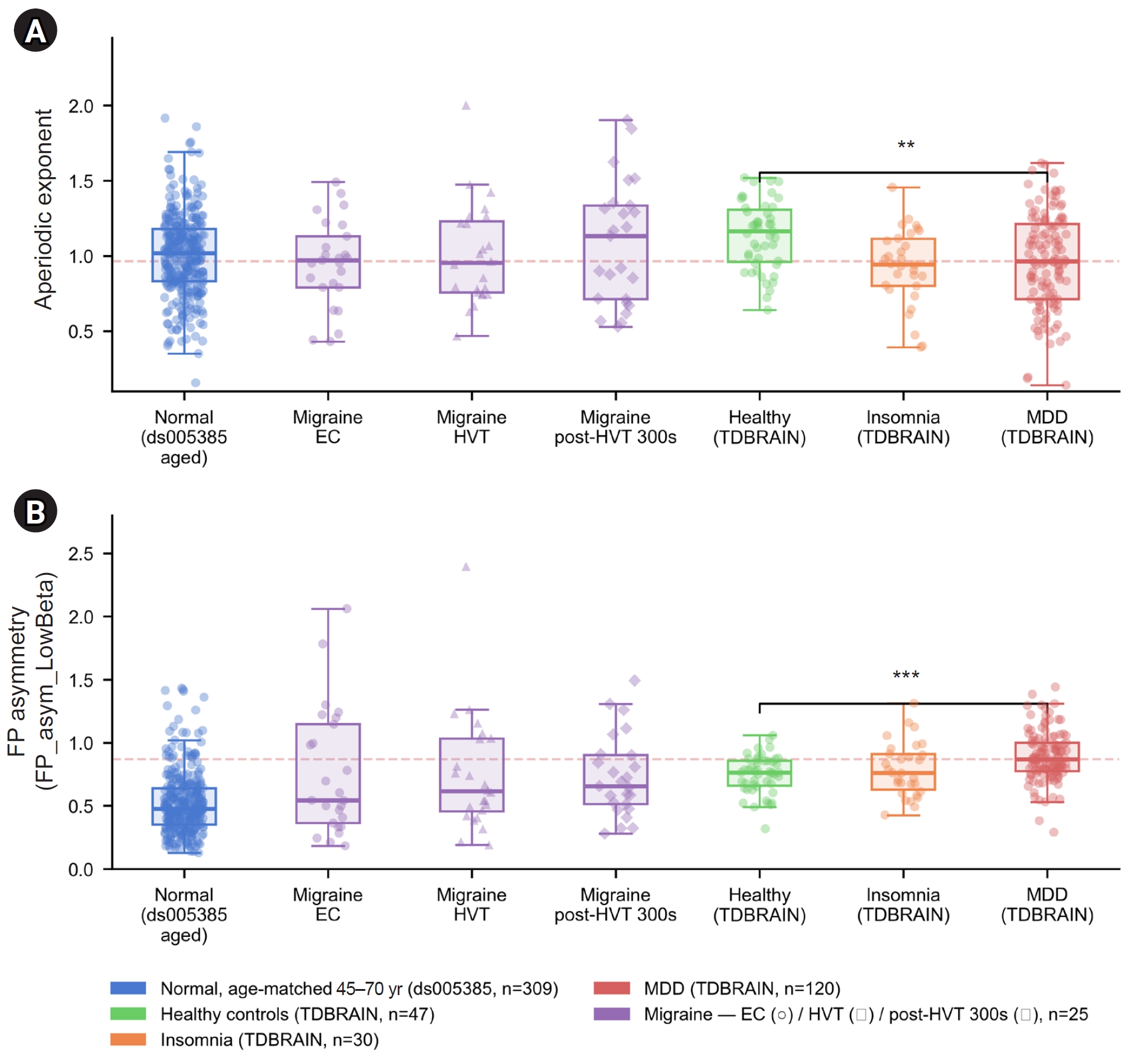
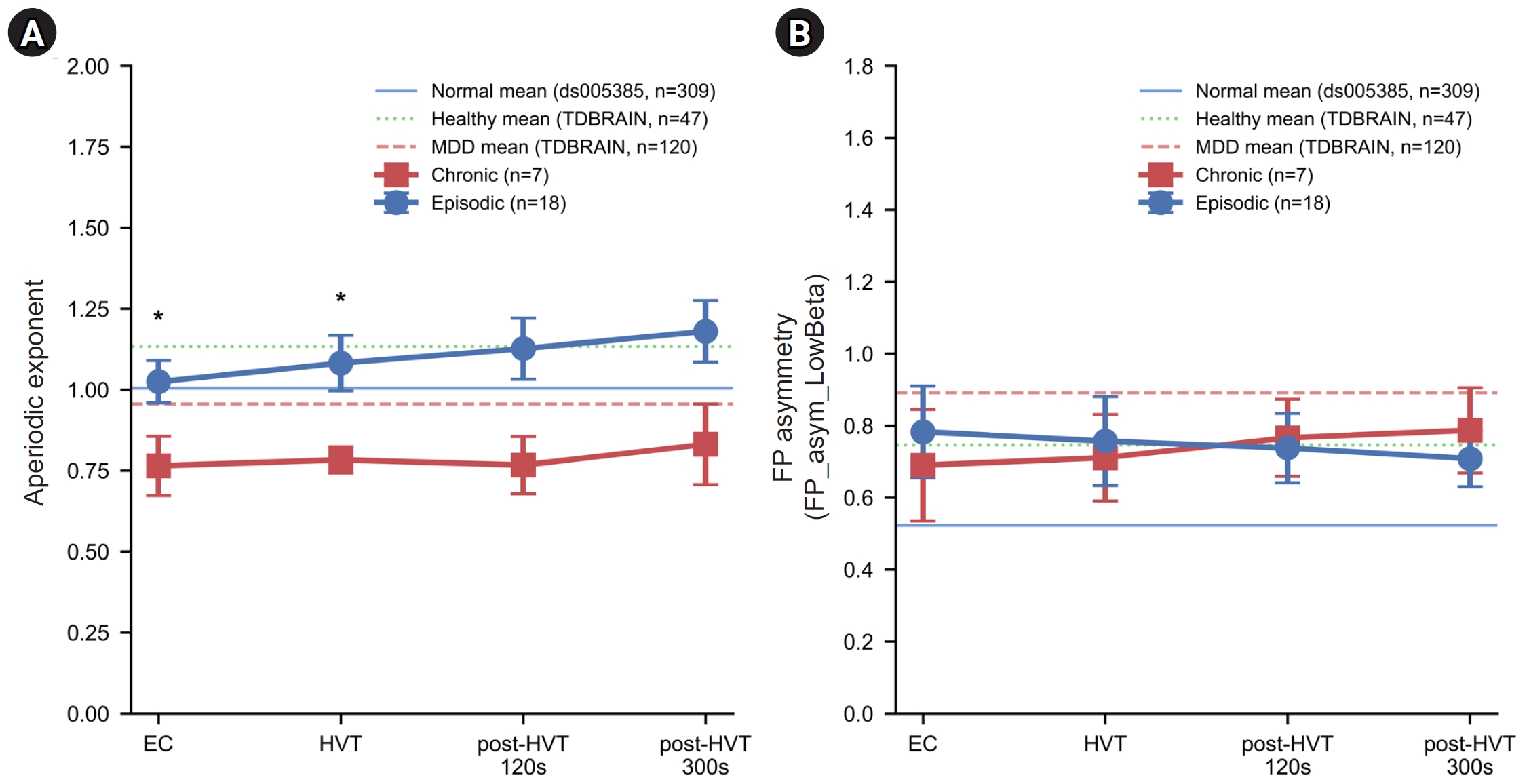


Figure 1.
Figure 2.
| Dataset | Participant (n) | Age (yr), mean (range) | Role/Description |
|---|---|---|---|
| ds005385 | 608 | 44.1 (20–70) | Part of the Dortmund Vital Study7; prospective resting-state EEG dataset for cognitive aging research; BIDS format; OpenNeuro. Age-matched subset 45–70 years (n=317) used for normative comparison; final n=309 after IQR×3 outlier removal. |
| TDBRAIN | 241 (subset) | 40.8 (17–78) | Two Decades-Brainclinics Research Archive for Insights in Neurophysiology.8 Original database: 1,274 participants (2001–2021). Publicly available subset used (OpenNeuro; n=241). Analyzed groups: MDD n=120 (after outlier removal), insomnia n=30, healthy controls n=47 (total n=197 analyzed). OCD (n=37) and burnout (n=6) excluded as not relevant to the depression-normative comparison framework. |
| Migraine patients (present study) | 25 | 60.0 (45–68) | Interictal migraine patients (ICHD-3); chronic migraine n=7, episodic migraine n=18; female n=17 (68%). EEG performed at least 48 hours after most recent headache attack. 2 data points removed as outliers (IQR×3). |
| Characteristic | Total (n=25) | Chronic migraine (n=7) | Episodic migraine (n=18) |
|---|---|---|---|
| Demographics | |||
| Age (yr) | 62.0 (55.0–65.0) | 63.0 (56.5–66.0) | 62.0 (55.0–65.0) |
| Female sex | 17 (68) | 5 (71) | 12 (67) |
| Headache characteristics | |||
| Disease duration (yr) | 3.0 (2.0–5.0) | 5.0 (4.0–5.0) | 3.0 (1.0–5.0) |
| Monthly headache days | 10.0 (7.0–20.0) | 25.0 (25.0–30.0) |
8.0 (5.0–10.0) |
| Monthly migraine days | 3.0 (2.0–10.0) | 10.0 (10.0–10.0) |
2.0 (1.0–3.0) |
| Aura | 4 (16) | 2 (29) | 2 (11) |
| MOH | 6 (24) | 6 (86) |
0 (0) |
| Acute medication | |||
| Triptans | 8 (32) | 3 (43) | 5 (28) |
| NSAIDs | 14 (56) | 3 (43) | 11 (61) |
| Preventive medication | |||
| Topiramate | 13 (52) | 5 (71) | 8 (44) |
| Valproate | 16 (64) | 5 (71) | 11 (61) |
| CGRP-targeted therapies | 4 (16) | 3 (43) | 1 (6) |
| Concomitant medications | |||
| SSRI | 14 (56) | 6 (86) | 8 (44) |
| Benzodiazepine | 11 (44) | 3 (43) | 8 (44) |
| Index | Healthy (n=47) | MDD (n=120) | Cohen’s d | p | Selection |
|---|---|---|---|---|---|
| Aperiodic exponent | 1.134±0.226 | 0.956±0.334 | –0.63 | 0.001 | Selected |
| FP_asym_LowBeta | 0.747±0.152 | 0.891±0.196 | +0.83 | <0.001 | Selected |
| FP_asym_Beta (broadband) | 0.832±0.163 | 0.986±0.221 | +0.79 | <0.001 | Excluded (collinear with FP_asym_LowBeta) |
| Alpha peak frequency (IAF) | 10.231±0.909 | 9.814±0.890 | –0.46 | 0.011 | Excluded (smaller effect) |
| fooof_TAR_log | 0.198±0.184 | 0.278±0.236 | +0.38 | 0.020 | Excluded (smaller effect) |
| Alpha peak prominence | 1.225±0.428 | 1.105±0.378 | –0.30 | 0.035 | Excluded (smaller effect) |
| FAA | –0.014±0.160 | 0.013±0.134 | +0.18 | 0.134 | Excluded (ns) |
| TBR | 6.686±4.688 | 6.213±5.549 | –0.09 | 0.086 | Excluded (ns) |
| Insomnia (n=30) for reference | - | - | - | - | Exponent: 0.929±0.253 (p=0.001 vs. healthy) |
| FP_asym_LowBeta: 0.788±0.213 (p=0.576 vs. healthy) |
| Index | Window | Chronic migraine (n=7) | Episodic migraine (n=18) | Cohen’s d | p_raw | p_FDR |
|---|---|---|---|---|---|---|
| Aperiodic exponent | EC | 0.765±0.243 | 1.025±0.278 | –1.00 | 0.041* | 0.064 |
| Aperiodic exponent | HVT | 0.783±0.100 | 1.082±0.363 | –1.12 | 0.047* | 0.064 |
| Aperiodic exponent | Post-HVT 120s | 0.767±0.235 | 1.127±0.400 | –1.10 | 0.055 | 0.064 |
| Aperiodic exponent | Post-HVT 300s | 0.831±0.330 | 1.180±0.403 | –0.95 | 0.064 | 0.064 |
| FP_asym_LowBeta | EC | 0.690±0.410 | 0.783±0.541 | –0.19 | 0.929 | 0.929 |
| FP_asym_LowBeta | HVT | 0.711±0.295 | 0.757±0.524 | –0.11 | 0.923 | 0.929 |
| FP_asym_LowBeta | Post-HVT 120s | 0.766±0.284 | 0.738±0.408 | 0.08 | 0.574 | 0.929 |
| FP_asym_LowBeta | Post-HVT 300s | 0.787±0.314 | 0.708±0.330 | 0.25 | 0.615 | 0.929 |
IQR, interquartile range; EEG, electroencephalography; BIDS, Brain Imaging Data Structure; MDD, major depressive disorder; OCD, obsessive-compulsive disorder; ICHD-3, International Classification of Headache Disorders, 3rd edition.
Values are median (interquartile range) or number (%). MOH, medication overuse headache (International Classification of Headache Disorders, 3rd edition criteria); NSAIDs, non-steroidal anti-inflammatory drugs; CGRP, calcitonin gene-related peptide; SSRI, selective serotonin reuptake inhibitor. p<0.001 versus episodic migraine (Fisher exact or Mann-Whitney U-test).
Values are mean±standard deviation (post-outlier removal) unless otherwise stated. p-values from Mann-Whitney U-test. qEEG, quantitative electroencephalography; TDBRAIN, Two Decades-Brainclinics Research Archive for Insights in Neurophysiology; MDD, major depressive disorder; FP_asym_LowBeta, frontal-parietal low-beta asymmetry; FP_asym_Beta, broadband beta variant; IAF, individual alpha frequency; fooof_TAR, FOOOF-corrected theta/alpha ratio; FAA, frontal alpha asymmetry; TBR, theta/beta ratio; ns, not significant.
Values are mean±standard deviation (post-outlier removal). Chronic migraine n=7; HVT n=6 (one outlier-removed data point). All comparisons are considered exploratory given the small chronic migraine subgroup (n=7). *Uncorrected p<0.05 (did not survive FDR correction). qEEG, quantitative electroencephalography; FP_asym_LowBeta, frontal-parietal low-beta asymmetry; p_raw, uncorrected Mann-Whitney U-test p-value; p_FDR, Benjamini-Hochberg false discovery rate-corrected p-value; EC, eyes closed; HVT, hyperventilation; post-HVT 120s, 120 seconds after hyperventilation; post-HVT 300s, 300 seconds after hyperventilation.
Table 1.
Table 2.
Table 3.
Table 4.
TOP


