 KHS


Articles
- Page Path
- HOME > Headache Pain Res > Volume 27(3); 2026 > Article
-
Original Article
Feasibility and Safety of Elexir, an External Trigeminal Nerve Electrical Stimulator for the Acute Treatment of Migraine -
Soo-Im Jang1
 , Soohyun Cho2,3, Mi Ji Lee1,4
-
Headache and Pain Research 2026;27(3):193-203.
DOI: https://doi.org/10.62087/hpr.2026.0041
Published online: October 30, 2026
1Department of Neurology, Seoul National University Hospital, Seoul, Republic of Korea
2Department of Neurology, Uijeongbu Eulji Medical Center, Uijeongbu, Republic of Korea
3Department of Neurology, Eulji University School of Medicine, Uijeongbu, Republic of Korea
4Graduate School of Translational Medicine, Seoul National University College of Medicine, Seoul, Republic of Korea
- Correspondence: Mi Ji Lee, M.D., Ph.D. Department of Neurology, Seoul National University Hospital, Seoul National University College of Medicine, 101 Daehak-ro, Jongno-gu, 03080 Seoul, Republic of Korea Tel: +82-2-2072-3925, Fax: +82-2-3672-7553, E-mail: mijilee.md@snu.ac.kr
© 2026 The Korean Headache Society
This is an Open Access article distributed under the terms of the Creative Commons Attribution Non-Commercial License (https://creativecommons.org/licenses/by-nc/4.0) which permits unrestricted non-commercial use, distribution, and reproduction in any medium, provided the original work is properly cited.
- 209 Views
- 4 Download


Abstract
-
Purpose
- xternal trigeminal nerve stimulation (eTNS) is a noninvasive neuromodulation technique used to treat migraine. This study evaluated the feasibility and safety of Elexir®, a newly developed eTNS device, for the acute treatment of migraine at home.
-
Methods
- This prospective, randomized, sham-controlled postmarketing study enrolled participants with migraine who reported 2–8 attacks per month. Participants were assigned 1:1 to verum or sham stimulation and instructed to use Elexir® at home for 60 minutes during an eligible migraine attack. Feasibility of home use was assessed in terms of per-protocol use and treatment completion at both the participant and session levels; session completion was defined by 60 (±5)-minute stimulation recorded in the device log. Assessments also included adverse events (AEs) and exploratory efficacy outcomes: changes in pain intensity, pain freedom and relief, and resolution of associated symptoms.
-
Results
- Of the 100 randomized participants, 79 formed the home-use population. Within this population, 78 (98.7%; 95% confidence interval [CI], 93.2%–99.8%) used Elexir® during an eligible migraine attack, and 75 (94.9%; 95% CI, 87.7%–98.0%) completed at least one session. Of the 139 treatment sessions conducted at home, 103 (74.1%; 95% CI, 66.2%–80.7%) were completed within the protocol-defined duration. Ten participants (10.0%) reported AEs and eight participants (8.0%) reported device-related AEs. No serious device-related AEs were observed. The groups did not differ significantly in exploratory efficacy outcomes.
-
Conclusion
- These findings support the feasibility of using Elexir® for the acute treatment of migraine; no serious device-related AEs were observed. Further studies are required to support efficacy.
INTRODUCTION
MATERIALS AND METHODS
RESULTS
DISCUSSION
CONCLUSION
AVAILABILITY OF DATA AND MATERIAL
The data are not publicly available due to privacy or ethical restrictions. The data supporting the findings of this study may be made available upon reasonable request, subject to institutional review and approval.
AUTHOR CONTRIBUTIONS
Conceptualization: MJL; Data Curation: SIJ, SC, MJL; Formal analysis: SIJ, MJL; Funding acquisition: MJL; Investigation: SIJ, SC, MJL; Methodology: MJL; Project administration: MJL; Resources: SC, MJL; Supervision: MJL; Visualization: SIJ; Writing–original draft: SIJ; Writing–review & editing: SIJ, SC, MJL.
CONFLICT OF INTEREST
Mi Ji Lee has received personal and institutional honoraria to serve as a clinical trial investigator, speaker, or consultant for AbbVie, Biohaven, Eli Lilly, Lundbeck, NuEyne Co., Novartis, Otsuka, Sanofi-Aventis, SK Pharm, Teva, Yuhan Company, and YuYu Pharma. The other authors have no other conflicts of interest to declare.
FUNDING STATEMENT
This work was supported by a Korea Medical Device Development Fund grant funded by the Korean government (RS-2023-00229484). The funders had no role in the design or conduct of the study; collection, management, analysis, or interpretation of the data; preparation, review, or approval of the manuscript; or decision to submit the manuscript for publication.
ACKNOWLEDGMENTS
None.
SUPPLEMENTARY MATERIAL
Supplementary Table 1.
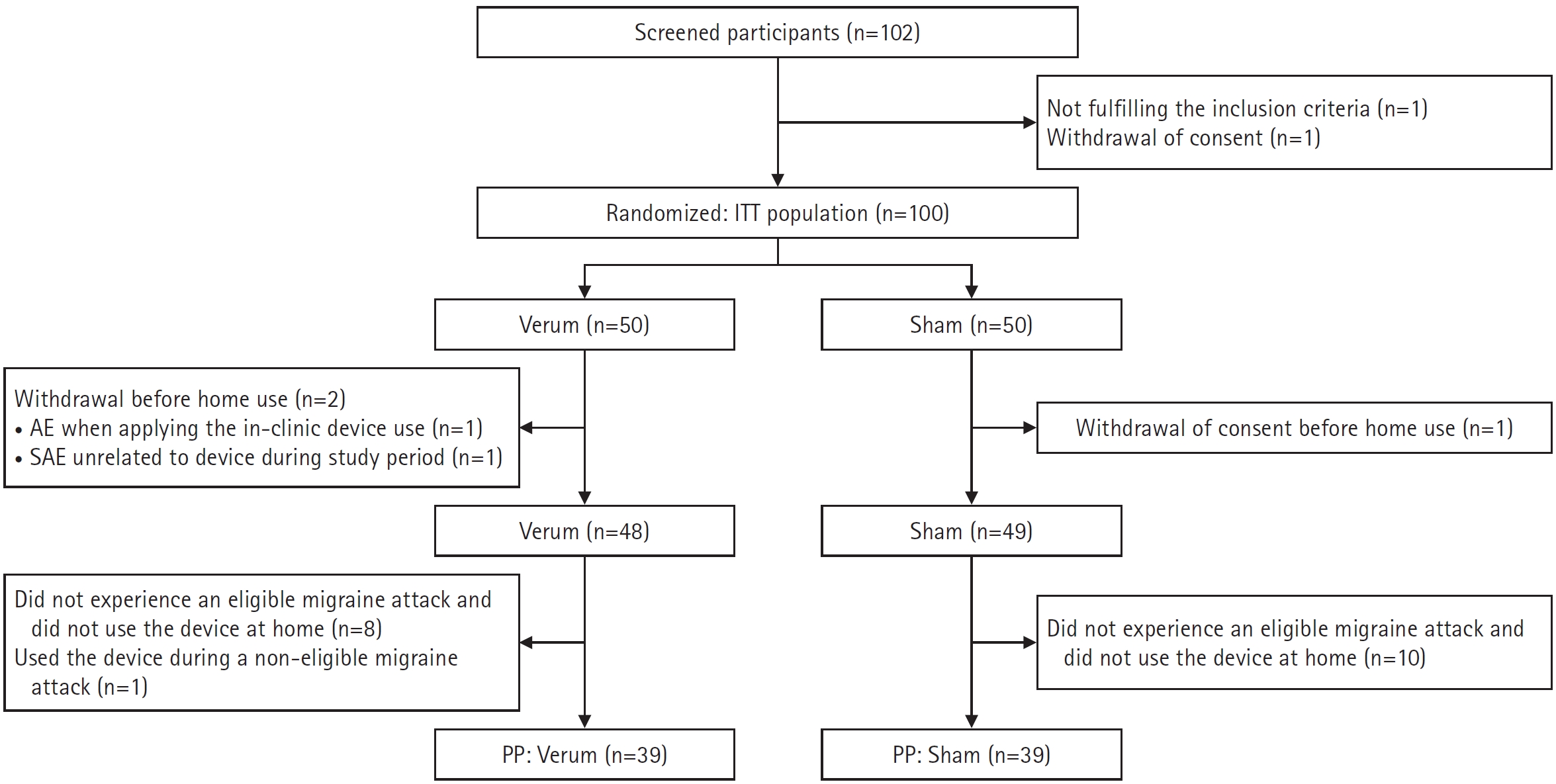
Values are presented as mean±standard deviation, n (%), n/N (%), or median (interquartile range), as appropriate. Headache intensity during the eligible migraine attack was measured on both a four-point pain intensity scale (0=no pain, 1=mild, 2=moderate, and 3=severe) and a VAS (0–10). Participants could report multiple associated symptoms but identified a single most bothersome associated symptom.
PP, per-protocol; VAS, visual analog scale.
Values are presented as median (interquartile range), n (%), or n/N (%). The effect estimate for the change in VAS score is the Hodges–Lehmann estimate of the between-group location shift; estimates for binary outcomes are risk ratios. All effect estimates are accompanied by 95% CIs.
CI, confidence interval; VAS, visual analog scale.
- 1. Stovner LJ, Hagen K, Linde M, Steiner TJ. The global prevalence of headache: an update, with analysis of the influences of methodological factors on prevalence estimates. J Headache Pain 2022;23:34.ArticlePubMedPMCPDF
- 2. GBD 2016 Headache Collaborators. Global, regional, and national burden of migraine and tension-type headache, 1990-2016: a systematic analysis for the Global Burden of Disease Study 2016. Lancet Neurol 2018;17:954-976.ArticlePubMedPMC
- 3. Safiri S, Pourfathi H, Eagan A, et al. Global, regional, and national burden of migraine in 204 countries and territories, 1990 to 2019. Pain 2022;163:e293-e309.ArticlePubMed
- 4. Blumenfeld AM, Bloudek LM, Becker WJ, et al. Patterns of use and reasons for discontinuation of prophylactic medications for episodic migraine and chronic migraine: results from the second international burden of migraine study (IBMS-II). Headache 2013;53:644-655.ArticlePubMed
- 5. Hepp Z, Bloudek LM, Varon SF. Systematic review of migraine prophylaxis adherence and persistence. J Manag Care Pharm 2014;20:22-33.ArticlePubMedPMC
- 6. Hepp Z, Dodick DW, Varon SF, Gillard P, Hansen RN, Devine EB. Adherence to oral migraine-preventive medications among patients with chronic migraine. Cephalalgia 2015;35:478-488.ArticlePubMedPDF
- 7. Katić BJ, Krause SJ, Tepper SJ, Hu HX, Bigal ME. Adherence to acute migraine medication: what does it mean, why does it matter? Headache 2010;50:117-129.ArticlePubMed
- 8. Ashina M, Hansen JM, Do TP, Melo-Carrillo A, Burstein R, Moskowitz MA. Migraine and the trigeminovascular system-40 years and counting. Lancet Neurol 2019;18:795-804.ArticlePubMedPMC
- 9. Riederer F, Penning S, Schoenen J. Transcutaneous supraorbital nerve stimulation (t-SNS) with the Cefaly® device for migraine prevention: a review of the available data. Pain Ther 2015;4:135-147.ArticlePubMedPMC
- 10. Chou DE, Shnayderman Yugrakh M, Winegarner D, Rowe V, Kuruvilla D, Schoenen J. Acute migraine therapy with external trigeminal neurostimulation (ACME): a randomized controlled trial. Cephalalgia 2019;39:3-14.ArticlePubMedPMCPDF
- 11. Chou DE, Gross GJ, Casadei CH, Yugrakh MS. External trigeminal nerve stimulation for the acute treatment of migraine: open-label trial on safety and efficacy. Neuromodulation 2017;20:678-683.ArticlePubMedPDF
- 12. Schoenen J, Vandersmissen B, Jeangette S, et al. Migraine prevention with a supraorbital transcutaneous stimulator: a randomized controlled trial. Neurology 2013;80:697-704.ArticlePubMedPMC
- 13. Headache Classification Committee of the International Headache Society (IHS). The International Classification of Headache Disorders, 3rd edition. Cephalalgia 2018;38:1-211.ArticlePubMedPMCPDF
- 14. Delbeke J, Pins D, Michaux G, Wanet-Defalque MC, Parrini S, Veraart C. Electrical stimulation of anterior visual pathways in retinitis pigmentosa. Invest Ophthalmol Vis Sci 2001;42:291-297.PubMedPDF
- 15. Vecchio E, Gentile E, Franco G, Ricci K, de Tommaso M. Effects of external trigeminal nerve stimulation (eTNS) on laser evoked cortical potentials (LEP): A pilot study in migraine patients and controls. Cephalalgia 2018;38:1245-1256.ArticlePubMedPDF
- 16. Tepper SJ, Grosberg B, Daniel O, et al. Migraine treatment with external concurrent occipital and trigeminal neurostimulation: a randomized controlled trial. Headache 2022;62:989-1001.ArticlePubMedPDF
REFERENCES
Figure & Data
References
Citations

 PubReader
 ePub Link
-
 Cite this Article
- Cite this Article
-
- Close
- Download Citation
- Close
 XML Download
- Figure
-
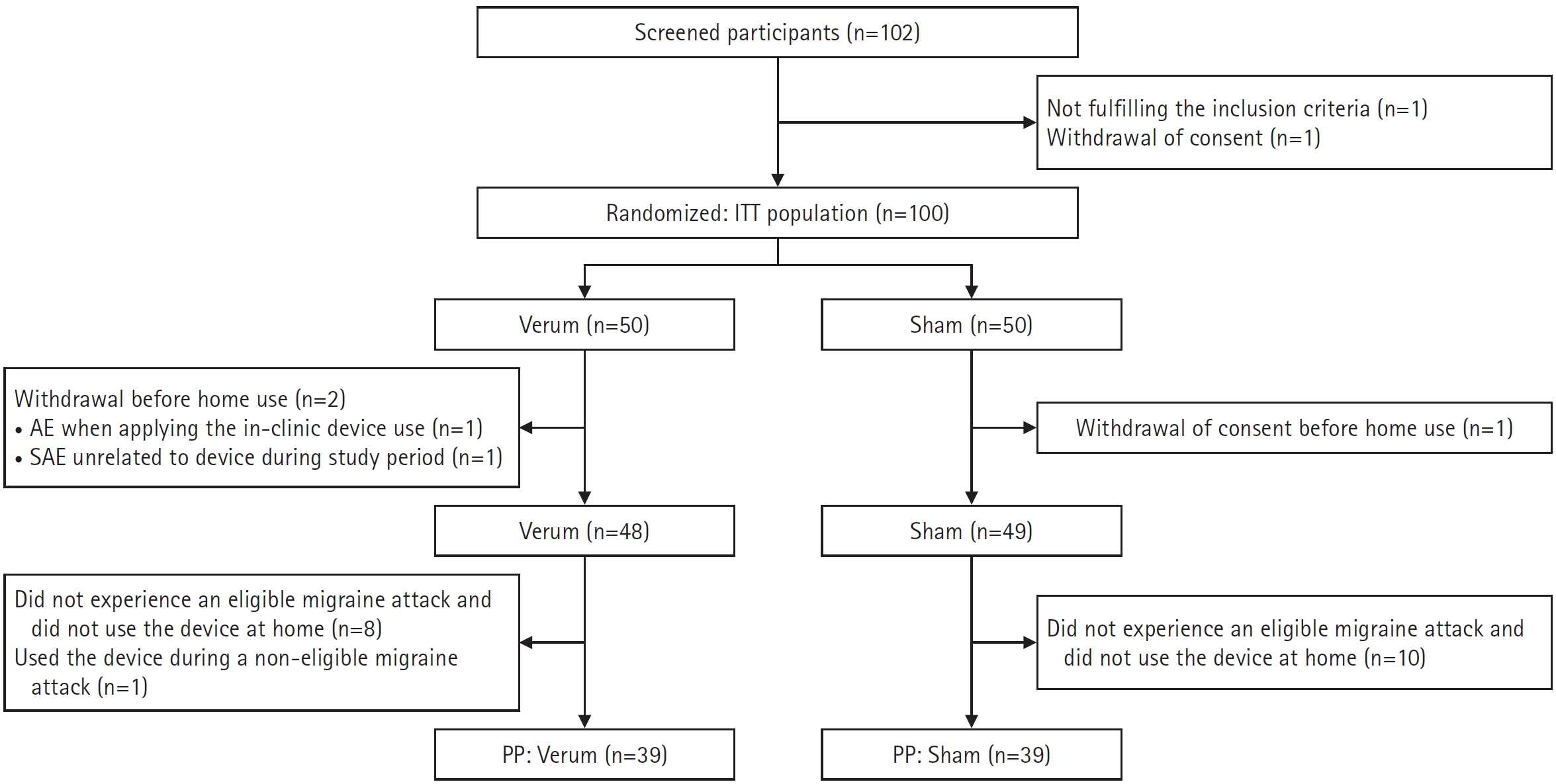
Figure 1.
| Variable | Per-protocol population (n=78) | Verum (n=39) | Sham (n=39) | p-value |
|---|---|---|---|---|
| User acceptability | ||||
| Button placement | 52 (66.7) | 26 (66.7) | 26 (66.7) | >0.999 |
| User manual | 61 (78.2) | 32 (82.1) | 29 (74.4) | 0.411 |
| Comfort while wearing the device | 48 (61.5) | 29 (74.4) | 19 (48.7) | 0.020* |
| Device size | 54 (69.2) | 29 (74.4) | 25 (64.1) | 0.326 |
| Device performance | ||||
| Operating conditions | 61 (78.2) | 32 (82.1) | 29 (74.4) | 0.411 |
| Output intensity | 51 (65.4) | 29 (74.4) | 22 (56.4) | 0.096 |
| Accuracy of output adjustment | 50 (64.1) | 30 (76.9) | 20 (51.3) | 0.018* |
| Overall user evaluation | ||||
| Overall satisfaction | 39 (50.0) | 23 (59.0) | 16 (41.0) | 0.113 |
| Time needed to adjust stimulation output (min) | 2.0 (1.0–3.0) | 2.0 (1.0–3.0) | 2.0 (1.0–3.0) | 0.178 |
| Variable | PP population (n=78) | Verum (n=39) | Sham (n=39) | p-value |
|---|---|---|---|---|
| Age (yr) | 42.9±11.6 | 43.2±10.8 | 42.6±12.5 | 0.839 |
| Female sex | 66 (84.6) | 30 (76.9) | 36 (92.3) | 0.114 |
| Disease duration (yr) | 8.5 (3.0–15.5) | 8.0 (3.0–20.0) | 10.0 (3.0–15.0) | 0.489 |
| Characteristics of the eligible migraine attack | ||||
| Presence of aura | 42 (53.8) | 20 (51.3) | 22 (56.4) | 0.821 |
| Pretreatment headache intensity | ||||
| Moderate (grade 2) | 66 (84.6) | 33 (84.6) | 33 (84.6) | >0.999 |
| Severe (grade 3) | 12 (15.4) | 6 (15.4) | 6 (15.4) | >0.999 |
| VAS score | 6.0 (5.0–7.0) | 6.0 (5.0–7.0) | 6.0 (5.0–7.0) | 0.686 |
| Associated symptoms | ||||
| Nausea | 48 (61.5) | 21 (53.8) | 27 (69.2) | 0.244 |
| Vomiting | 7 (9.0) | 3 (7.7) | 4 (10.3) | >0.999 |
| Photophobia | 42 (53.8) | 24 (61.5) | 18 (46.2) | 0.256 |
| Phonophobia | 39 (50.0) | 20 (51.3) | 19 (48.7) | >0.999 |
| Most bothersome associated symptom | 0.066 | |||
| Nausea | 36 (46.2) | 15 (38.5) | 21 (53.8) | |
| Vomiting | 1 (1.3) | 1 (2.6) | 0 (0.0) | |
| Photophobia | 23 (29.5) | 16 (41.0) | 7 (17.9) | |
| Phonophobia | 18 (23.1) | 7 (17.9) | 11 (28.2) | |
| History of preventive medication use (n=50) | 18/50 (36.0) | 7/25 (28.0) | 11/25 (44.0) | 0.377 |
| Number of preventive medication classes (n=50) | 0.0 (0.0–1.0) | 0.0 (0.0–1.0) | 0.0 (0.0–1.0) | 0.236 |
| Monthly headache days (n=50) | 5.0 (3.0–7.0) | 5.0 (3.0–7.0) | 5.0 (3.5–7.0) | 0.694 |
| Monthly migraine headache days (n=50) | 4.0 (2.0–6.0) | 4.0 (2.0–6.0) | 4.0 (3.0–5.5) | 0.673 |
| Days of acute medication use per month (n=50) | 4.0 (2.0–6.0) | 4.0 (2.0–6.5) | 4.0 (2.5–5.0) | 0.797 |
| Triptan responder (n=30) | 27/30 (90.0) | 12/14 (85.7) | 15/16 (93.8) | 0.586 |
| Variable | Verum (n=39) | Sham (n=39) | Effect estimate (95% CI) | p-value |
|---|---|---|---|---|
| Headache intensity (VAS) | ||||
| Before device use | 6.0 (5.0–7.0) | 6.0 (5.0–7.0) | 0.686 | |
| At 1 hr after initiating stimulation | 4.0 (2.0–6.0) | 3.0 (2.0–5.0) | 0.636 | |
| Change at 1 hr (ΔVAS) | 2.0 (0.0–4.0) | 2.0 (1.0–4.0) | 0.0 (–1.0 to 1.0) | 0.480 |
| Pain freedom after initiating stimulation | ||||
| At 1 hr | 2 (5.1) | 4 (10.3) | 0.500 (0.097 to 2.573) | 0.675 |
| At 2 hr | 7 (17.9) | 7 (17.9) | 1.000 (0.387 to 2.583) | >0.999 |
| At 24 hr | 20 (51.3) | 24 (61.5) | 0.833 (0.562 to 1.236) | 0.494 |
| Pain relief after initiating stimulation | ||||
| At 1 hr | 22 (56.4) | 24 (61.5) | 0.917 (0.633 to 1.328) | 0.818 |
| At 2 hr | 24 (61.5) | 28 (71.8) | 0.857 (0.625 to 1.176) | 0.472 |
| At 24 hr | 32 (82.1) | 36 (92.3) | 0.889 (0.748 to 1.056) | 0.310 |
| Resolution of associated symptoms after initiating stimulation | ||||
| At 1 hr | 11 (28.2) | 13 (33.3) | 0.846 (0.433 to 1.652) | 0.807 |
| At 2 hr | 15 (38.5) | 18 (46.2) | 0.833 (0.494 to 1.405) | 0.647 |
| Freedom from the most bothersome symptom after initiating stimulation | ||||
| At 1 hr | 11 (28.2) | 13 (33.3) | 0.846 (0.433 to 1.652) | 0.807 |
| At 2 hr | 15 (38.5) | 18 (46.2) | 0.833 (0.494 to 1.405) | 0.647 |
| Rescue medication use (2–24 hr) | 18 (46.2) | 18 (46.2) | 1.000 (0.619 to 1.615) | >0.999 |
| Rescue medication use among participants with pain freedom at 24 hr (n=44) | 7/20 (35.0) | 9/24 (37.5) | 0.933 (0.424 to 2.056) | >0.999 |
| Rescue medication use among participants with pain relief at 24 hr (N=68) | 14/32 (43.8) | 15/36 (41.7) | 1.050 (0.605 to 1.822) | >0.999 |
Values are presented as number (%) or median (interquartile range). Satisfaction was defined by a Likert score of 4 or 5. The proportions of satisfied participants were compared between groups using the chi-square test (*p<0.05).
Values are presented as mean±standard deviation, n (%), n/N (%), or median (interquartile range), as appropriate. Headache intensity during the eligible migraine attack was measured on both a four-point pain intensity scale (0=no pain, 1=mild, 2=moderate, and 3=severe) and a VAS (0–10). Participants could report multiple associated symptoms but identified a single most bothersome associated symptom. PP, per-protocol; VAS, visual analog scale.
Values are presented as median (interquartile range), n (%), or n/N (%). The effect estimate for the change in VAS score is the Hodges–Lehmann estimate of the between-group location shift; estimates for binary outcomes are risk ratios. All effect estimates are accompanied by 95% CIs. CI, confidence interval; VAS, visual analog scale.
Table 1.
Table 2.
Table 3.
TOP


