Feasibility and Safety of Elexir, an External Trigeminal Nerve Electrical Stimulator for the Acute Treatment of Migraine
Article information

Abstract
Purpose
xternal trigeminal nerve stimulation (eTNS) is a noninvasive neuromodulation technique used to treat migraine. This study evaluated the feasibility and safety of Elexir®, a newly developed eTNS device, for the acute treatment of migraine at home.
Methods
This prospective, randomized, sham-controlled postmarketing study enrolled participants with migraine who reported 2–8 attacks per month. Participants were assigned 1:1 to verum or sham stimulation and instructed to use Elexir® at home for 60 minutes during an eligible migraine attack. Feasibility of home use was assessed in terms of per-protocol use and treatment completion at both the participant and session levels; session completion was defined by 60 (±5)-minute stimulation recorded in the device log. Assessments also included adverse events (AEs) and exploratory efficacy outcomes: changes in pain intensity, pain freedom and relief, and resolution of associated symptoms.
Results
Of the 100 randomized participants, 79 formed the home-use population. Within this population, 78 (98.7%; 95% confidence interval [CI], 93.2%–99.8%) used Elexir® during an eligible migraine attack, and 75 (94.9%; 95% CI, 87.7%–98.0%) completed at least one session. Of the 139 treatment sessions conducted at home, 103 (74.1%; 95% CI, 66.2%–80.7%) were completed within the protocol-defined duration. Ten participants (10.0%) reported AEs and eight participants (8.0%) reported device-related AEs. No serious device-related AEs were observed. The groups did not differ significantly in exploratory efficacy outcomes.
Conclusion
These findings support the feasibility of using Elexir® for the acute treatment of migraine; no serious device-related AEs were observed. Further studies are required to support efficacy.
INTRODUCTION
Migraine is a primary headache disorder with a global prevalence of approximately 14% and is one of the leading causes of disability worldwide.1-3 Despite the substantial disease burden, adherence and persistence with acute and preventive treatments for migraine remain limited due to intolerable adverse events (AEs), insufficient efficacy, and contraindications.4-7 These limitations highlight an unmet clinical need for alternative or adjunctive treatment options, including neuromodulation approaches.
The pathophysiology of migraine is multifactorial, with the trigeminovascular system playing the most important role.8 External trigeminal nerve stimulation (eTNS) non-invasively delivers electrical stimulation to the supraorbital branch of the trigeminal nerve.9 Randomized trials have demonstrated the safety and efficacy of eTNS for both acute treatment and prevention of episodic migraine, and Cefaly (Cefaly Technology, Belgium), the first commercially available eTNS device, has received regulatory approval for acute and preventive treatment of migraine from the U.S. Food and Drug Administration (FDA).10-12
Current evidence for the efficacy and safety of eTNS for acute migraine treatment has been provided only based on Cefaly. Elexir (NuEyne Inc., South Korea) is a newly developed eTNS device that was cleared by the U.S. FDA through the 510(k) pathway (K211380) based on substantial equivalence to Cefaly. The device also received CE markings under the Medical Device Directive (CE-MDD), Health Canada, and approval from the Korean FDA. This study aimed to assess the feasibility and safety of Elexir for the acute treatment of migraine.
MATERIALS AND METHODS
1. Ethics and consent statement
The Institutional Review Board of Seoul National University approved the study protocol (reference number: SNU-2302-070-1405; date of approval: June 27, 2023). The study was conducted in accordance with the ethical guidelines of the Declaration of Helsinki of the World Medical Association. All the participants provided written informed consent prior to participating in the study. As this study enrolled participants who were between the ages of 19 and 65 years, obtaining consent from a parent or guardian was not required.
2. Study design and population
This was a prospective, randomized, double-blind, sham-controlled, post-marketing clinical trial of Elexir for the acute treatment of migraine, conducted across two headache centers in South Korea (Seoul National University Hospital and Uijeongbu Eulji Medical Center).
Participants were considered eligible for enrollment if they: were aged ≥19 and <65 years; met the diagnostic criteria for migraine without aura or migraine with aura according to The International Classification of Headache Disorders, 3rd edition (2018, Sections 1.1 and 1.2);13 patients with typical aura without headache, migraine with brainstem aura, and hemiplegic migraine were excluded; had a history of migraine for at least 1 year; experienced migraine onset before age 50; reported 2–8 migraine attacks per month during the 2 months preceding screening; and provided written informed consent. A migraine attack was defined as a headache lasting 4–72 hours (untreated or unsuccessfully treated) with unilateral throbbing pain of moderate or severe intensity. The exclusion criteria were predefined as follows: inability to distinguish migraine from tension-type headache; ≥15 headache days per month; supraorbital nerve block within 4 months prior to screening; botulinum toxin injection for migraine prevention within 4 months prior to screening; change in preventive migraine therapy within 3 months prior to screening; contraindications to use of the study medical device, including implanted metallic or electronic devices such as deep brain stimulators or cardiac pacemakers (excluding dental implants). Additional exclusion criteria are listed in Supplementary Material (Supplementary Appendix 1, available online).
The sample size was calculated based on a previous study on eTNS.10 A two-sample t-test assuming a two-sided significance level of 5% and 80% power was used. Allowing for a 20% dropout rate, the calculated sample size was increased conservatively.
3. Device information
Participants used a portable eTNS device (Elexir; model ALLIVE2), which delivers transcutaneous electrical stimulation to the supraorbital branch of the trigeminal nerve via forehead electrodes. The device has been approved for two stimulation programs, an acute treatment mode (60 minutes) and a preventive daily-use mode (20 minutes), and is designed as a wearable, home-use neuromodulation system. The acute stimulation mode provides a pulsed current at 100 Hz for 60 minutes, consisting of a ramp-up, stable-intensity, and ramp-down phase. Device output parameters included a maximum current of 16 mA, maximum voltage of 8±1 V (500 Ω load), and 250-µs pulse width. The sham device was identical in appearance and interface to the active device but delivered only a minimal symmetric biphasic pulse (0.5 mA, 50 μs) at 30 seconds interval to monitor electrode-skin contact. This stimulation was below the somatosensory threshold and, therefore, not perceptible to participants and was insufficient to produce any therapeutic effects.14
4. Treatment protocol
The patients were randomized to the verum and sham stimulation groups at a 1:1 ratio. Both investigators and patients were blinded to the randomization process, and a third party was responsible for randomization and concealment. After randomization, all participants underwent in-clinic training on the use of the allocated device, including device application and stimulation. Following the training, participants were instructed to self-apply the allocated device at home for 60 minutes (±5 minutes) at the onset of an eligible migraine attack, defined as: 1) migraine-specific headache with at least one associated symptom (photophobia, phonophobia, nausea, or vomiting); 2) moderate or severe pain intensity within 2 hours of onset; 3) no prior headache within the preceding 48 hours; 4) not spontaneously resolving; and 5) no use of acute migraine medication before device application. Participants were followed for up to 8 weeks after enrollment for the occurrence of an eligible migraine attack. Participants completed study questionnaires assessing changes in pain intensity, resolution of associated symptoms, and rescue medication use at prespecified post-treatment time points, as applicable. After one completed stimulation session, participants were required to visit the study site within 7 days to return the device and submit study-related material, including headache diaries and AE reporting forms. When an eligible migraine attack occurred and the device was applied, the use of any acute migraine medication was prohibited for the first 2 hours after device initiation. After 2 hours, permitted acute migraine treatments (including triptans, ergots, nonsteroidal anti-inflammatory drugs, acetaminophen, combination analgesics, and lasmiditan) were administered as needed.
5. Analysis populations
The intention-to-treat (ITT) population included all randomized participants. The home-use population included participants who used the device at home at least once, regardless of whether the treated migraine attack met the eligibility criteria. The per-protocol (PP) population included participants who used the device at home during at least one eligible migraine attack.
6. Study variables
Baseline demographic and clinical variables included age, sex, disease duration, history of preventive medication use, monthly headache days, monthly migraine headache days, monthly acute medication use days, and response to triptans. Characteristics of the eligible migraine attack included pretreatment headache intensity, the presence of aura, associated symptoms, including nausea, vomiting, photophobia, and phonophobia, and the most bothersome associated symptom. Pretreatment headache intensity was assessed using both a 4-point pain intensity scale (0=no pain, 1=mild, 2=moderate, and 3=severe) and a visual analog scale (VAS; 0–10). Several of these baseline clinical variables were added to the data collection protocol after study initiation and were therefore available only for a subset of participants. Device-log data were used to determine the number and duration of home-use stimulation sessions. For the session-level feasibility analysis, home-use device-log entries with a stimulation duration of ≥1 minute were considered treatment sessions, thereby excluding brief device activations or immediate shutdowns that were unlikely to represent treatment attempts. A completed treatment session was defined as a stimulation duration of 60±5 minutes based on device-logged data. Safety variables included the occurrence of AEs, their relationship to device use (device-related or device-unrelated), serious adverse events (SAEs), and discontinuation owing to AEs. Patient satisfaction with the device was evaluated using a questionnaire based on a 5-point Likert scale (1=very dissatisfied; 2=dissatisfied; 3=neutral; 4=satisfied; 5=very satisfied). Satisfaction was defined as a score of 4 or 5. Efficacy variables included changes in headache intensity, pain freedom, pain relief, resolution of associated symptoms, freedom from the most bothersome associated symptom, and rescue medication use. Post-treatment headache intensity was assessed using the VAS at 1 hour after initiating stimulation and using a 4-point pain intensity scale at 1, 2, and 24 hours after initiating stimulation. Pain freedom was defined as a reduction from moderate or severe intensity (grade 2 or 3) at baseline to no headache (grade 0), whereas pain relief was defined as a reduction from moderate or severe intensity (grade 2 or 3) at baseline to mild or no headache (grade 0 or 1). Both variables were assessed at 1, 2, and 24 hours after initiating stimulation. Resolution of associated symptoms and freedom from the most bothersome associated symptom were assessed using binary (yes/no) questionnaire items at 1 and 2 hours after initiating stimulation. Data on the use of rescue medication between 2 and 24 hours after initiating stimulation were also collected.
7. Outcomes
The primary outcome was the home-use feasibility of eTNS for acute migraine attacks. Home-use feasibility was evaluated in the home-use population using the following measures: 1) appropriate device use, defined as the proportion of participants who used the device during an eligible migraine attack; 2) participant-level treatment completion, defined as the proportion of participants who completed at least one stimulation session within the protocol-defined duration of 60±5 minutes, as determined from device-log data; and 3) session-level treatment completion, defined as the proportion of home-use treatment sessions lasting ≥1 minute that were completed within the protocol-defined duration of 60±5 minutes.
Safety outcomes were evaluated in the ITT population and included 1) the proportion of participants reporting AEs, 2) classification of AEs by device relatedness, and 3) identification of SAEs and discontinuations due to AEs. Patient satisfaction and exploratory efficacy outcomes were evaluated in the PP population. The primary exploratory efficacy outcome was the change in VAS score from before device application to 1 hour after initiating stimulation. Secondary exploratory efficacy outcomes included the proportions of participants reporting pain freedom, pain relief, resolution of associated symptoms, freedom from the most bothersome associated symptom, and the use of rescue medication.
8. Statistical analysis
Continuous variables following a normal distribution were presented as mean±standard deviation, whereas those that did not meet normality assumptions were expressed as median with interquartile range (IQR). Categorical variables were described as counts and percentages. Group comparisons were performed using the independent-samples t-test or Mann-Whitney U-test for continuous variables, and the chi-square test or Fisher’s exact test for categorical variables, depending on distributional characteristics. To assess potential attrition bias, baseline demographic and clinical characteristics were compared between the PP and non-PP populations. For home-use feasibility outcomes, 95% confidence intervals (CIs) for proportions were calculated using the Wilson score method. As a sensitivity analysis of home-use feasibility, participant-level treatment completion was additionally evaluated for the first eligible migraine attack in the PP population. For the analysis of patient satisfaction, responses were dichotomized as satisfied (scores of 4 or 5) and not satisfied (scores of 1–3), and the proportions of satisfied participants were compared between the verum and sham groups using the chi-square test. For exploratory efficacy outcomes, effect estimates with corresponding 95% CIs were calculated. The between-group effect for the change in VAS score was estimated using the Hodges-Lehmann estimator with a corresponding 95% CI. Effect estimates for binary efficacy outcomes were expressed as risk ratios with corresponding 95% CIs, with the sham group as the reference. Statistical significance was determined using a two-sided p-value of <0.05. No interim analyses were conducted, and missing data were analyzed without imputation. All statistical analyses were performed using the IBM SPSS Statistics software (version 29.0; IBM Corp.).
RESULTS
1. Participant disposition and analysis populations
A total of 102 individuals were screened and provided written informed consent between November 2023 and June 2024. Of these, two were excluded before randomization: one did not meet the inclusion criteria and the other withdrew consent before in-clinic device training. The remaining 100 participants were randomized and constituted the ITT population. All participants in the ITT population underwent in-clinic device training before home use. Three participants discontinued the study before home device use: one voluntarily withdrew consent, one withdrew due to an AE during in-clinic device application, and one discontinued due to a SAE unrelated to the device. Of the remaining 97 participants, 18 did not experience an eligible migraine attack during the study period and therefore did not use the device at home, whereas one participant used the device during a non-eligible migraine attack. Thus, the home-use population comprised 79 participants. The PP population consisted of 78 participants, defined as those who used the device at home during an eligible migraine attack. A flowchart of the population disposition is shown in Figure 1.
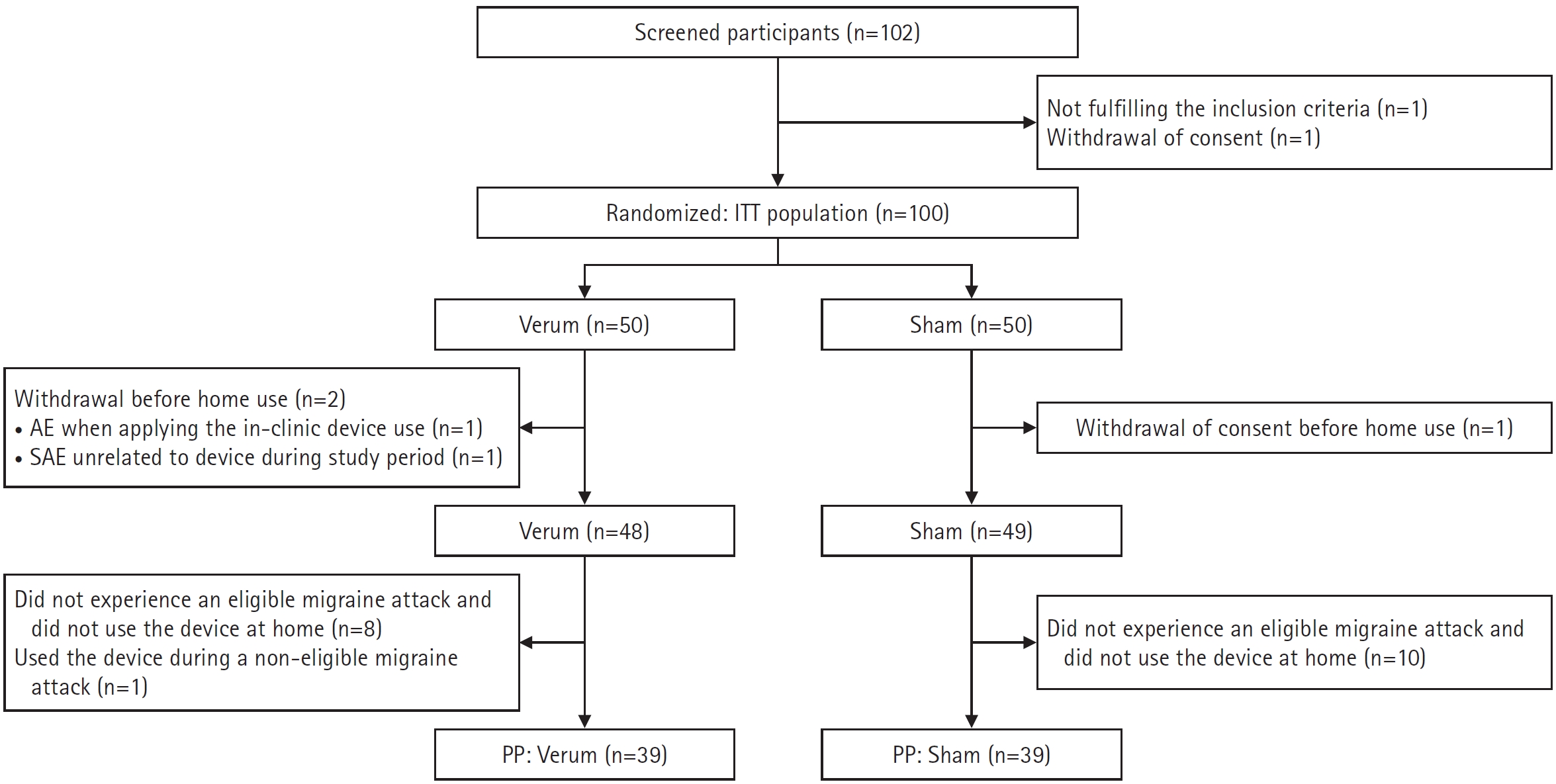
Study flowchart.
ITT, intention-to-treat; AE, adverse event; SAE, serious adverse event; PP, per-protocol.
2. Home-use feasibility
Home-use feasibility was evaluated in the home-use population (n=79). Of these participants, 78 (98.7%; 95% CI, 93.2%–99.8%) used the device during an eligible migraine attack, whereas one participant used the device during a non-eligible attack. Seventy-five participants (94.9%; 95% CI, 87.7%–98.0%) had at least one device-log-confirmed completed stimulation session within the protocol-defined duration of 60±5 minutes. Three participants had home-use sessions recorded in the device logs but did not complete a session within the predefined duration, with maximum stimulation durations of 25, 27, and 46 minutes, respectively. In one of these participants, the incomplete session was terminated because of an impedance-error shutdown. For one participant in sham group, home device use for 60 minutes was reported in the study records, but the corresponding home-use session could not be confirmed from the device logs. In a sensitivity analysis restricted to the first eligible migraine attack, 72 of 78 participants (92.3%; 95% CI, 84.2%–96.4%) had a device-log-confirmed completed stimulation session within the protocol-defined duration of 60±5 minutes. After excluding in-clinic training sessions and brief device activations lasting <1 minute, a total of 139 home-use treatment sessions were identified from the device logs. Of these, 103 sessions (74.1%; 95% CI, 66.2%–80.7%) were completed within the protocol-defined duration of 60±5 minutes. Among participants in the verum group who completed a treatment session, the median stimulation current was 5.1 mA (IQR, 3.34–7.23 mA).
3. Safety
In the ITT analysis, 10 participants (10.0%) reported AEs during the study period, including eight in the verum group and two in the sham group, with no significant difference between the two groups (p=0.092). Eight participants (8.0%) experienced device-related AEs, including somnolence (n=2; one in each group), skin eruption and pruritus (n=1; verum), aggravated headache (n=1; verum), pulling sensation in the forehead (n=1; verum), tingling over the forehead or at the patch application site (n=2; verum), and afterimaging (n=1; sham). All device-related AEs were transient and resolved without intervention. The longest-lasting AE was somnolence in the sham group, which persisted for up to 2 weeks. No serious device-related AEs were reported. Two patients in the verum group reported AEs categorized as having a weak or no relationship with device use. One patient reported transient pressure-like discomfort and hyperemia in the left eye, which resolved on the same day and was considered to have a low likelihood of being related to device use. Another participant was diagnosed with papillary thyroid carcinoma, which was determined to be a SAE that was unrelated to the device.
4. Patient satisfaction
In the PP population, 78 participants who used the device during at least one eligible migraine attack completed a usability questionnaire using a 5-point Likert scale. Participant satisfaction with device usability and performance is presented in Table 1. In terms of user acceptability, satisfaction with button placement, user manual, comfort while wearing the device, and device size were reported by 66.7% (52/78), 78.2% (61/78), 61.5% (48/78), and 69.2% (54/78) of participants, respectively. Regarding device performance, satisfaction with the operating conditions, output intensity, and accuracy of output adjustment was reported by 78.2% (61/78), 65.4% (51/78), and 64.1% (50/78), respectively. Overall satisfaction during device use was reported by 50.0% (39/78) of participants, and the median time required to adjust the stimulation output was 2.0 minutes (IQR, 1.0–3.0 minutes).
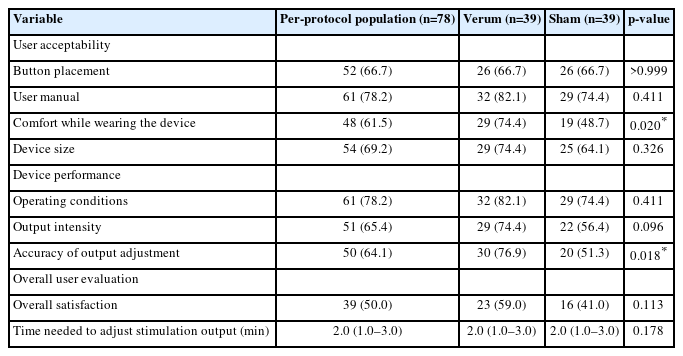
Satisfaction with device usability and performance in the verum and sham groups
In comparisons between the verum and sham groups, satisfaction with wearing comfort was significantly higher in the verum group than in the sham group (74.4% vs. 48.7%; p=0.020). Satisfaction with the output intensity was higher in the verum group than in the sham group (74.4% vs. 56.4%), although the difference was not statistically significant (p=0.096). Satisfaction with the accuracy of the output adjustment was also significantly higher in the verum group than in the sham group (76.9% vs. 51.3%; p=0.018). Overall satisfaction did not differ significantly between groups (59.0% vs. 41.0%; p=0.113) (Table 1).
5. Efficacy
The efficacy analysis was performed in the PP population (n=78; mean age, 42.9±11.6 years; female, 84.6%), defined as participants who used the device during at least one eligible migraine attack. Baseline demographics and characteristics of the PP population are shown in Table 2. The median disease duration was 8.5 years (IQR, 3.0–15.5 years). Among the treated eligible migraine attacks, all were of moderate or severe intensity and were accompanied by at least one associated symptom. Of the 78 participants, 66 participants (84.6%) had moderate headache intensity, and median VAS score was 6.0 (IQR, 5.0–7.0). The reported associated symptoms included nausea (61.5%), photophobia (53.8%), phonophobia (50.0%), and vomiting (9.0%). The most bothersome associated symptoms were nausea (46.2%), photophobia (29.5%), phonophobia (23.1%), and vomiting (1.3%). To assess potential attrition bias, the available baseline demographic and clinical characteristics were compared between the PP population (n=78) and the non-PP population (n=22). No statistically significant differences were observed between the two populations (Supplementary Table 1, available online).
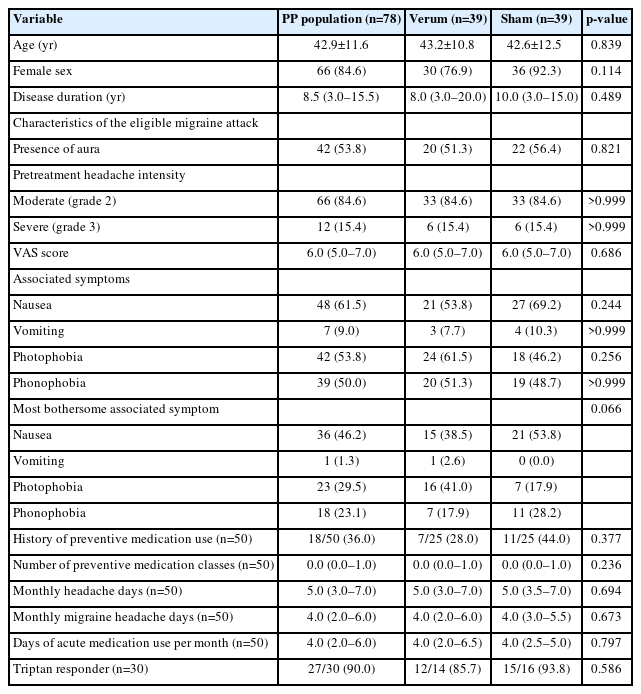
Demographic and clinical characteristics of the study participants
Exploratory efficacy outcomes are presented in Table 3. The median reduction in VAS score at 1 hour was 2.0 (IQR, 0.0–4.0) in the verum group and 2.0 (IQR, 1.0–4.0) in the sham group (Hodges–Lehmann estimate, 0.0; 95% CI, –1.0 to 1.0; p=0.480). No statistically significant between-group differences were observed in pain freedom or pain relief at 1, 2, or 24 hours after initiating stimulation. Similarly, the resolution of associated symptoms and freedom from the most bothersome associated symptom at 1 and 2 hours did not differ significantly between the groups. Rescue medication use between 2 and 24 hours was reported by 18 of 39 participants (46.2%) in each group. Among participants who achieved pain freedom or pain relief at 24 hours, rescue medication use also did not differ significantly between the groups (Table 3).
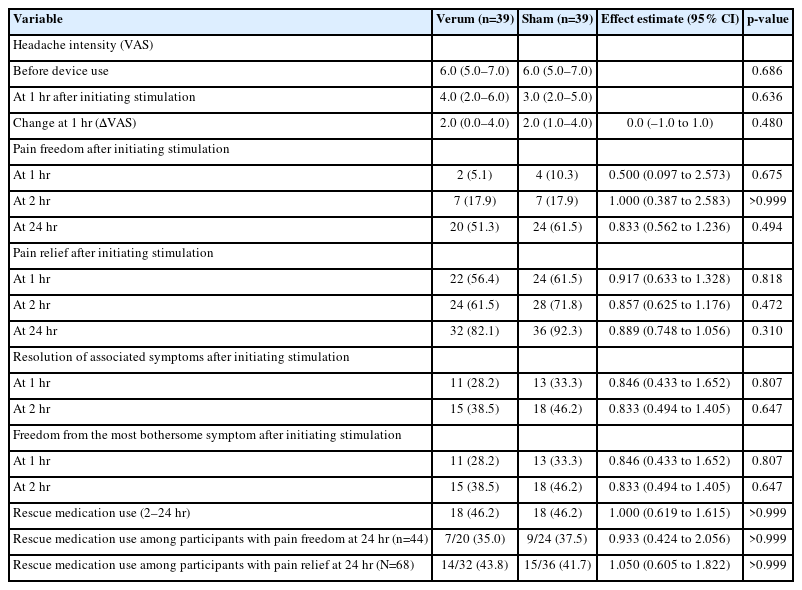
Efficacy outcomes in the verum and sham stimulation groups
DISCUSSION
Our findings support the feasibility of home use of Elexir for the acute treatment of migraine, with most participants who used the device at home completing at least one stimulation session within the protocol-defined duration. No serious device-related AEs were observed in this sample. Exploratory efficacy findings showed no significant differences between verum and sham stimulation in pain freedom, pain relief, or resolution of associated symptoms following treatment.
At the participant level, most participants who used the device at home completed at least one stimulation session, and an impedance-error shutdown resulting in incomplete treatment was identified in only one participant, suggesting that device-related interruption was uncommon. At the session level, 74.1% of home-use treatment sessions were completed within the protocol-defined duration. These findings support the feasibility of using the device in a home setting.
In our study, device-related AEs occurred in 8.0%; no serious device-related AEs were identified. Previous studies on eTNS have similarly reported only minor AEs, such as paresthesia, nausea, headache, and discomfort, and no SAEs, which is consistent with our findings.10,11,15,16 These results provide additional safety data on eTNS for the acute treatment of migraine.
Satisfaction with individual aspects of device usability and performance varied across measures, ranging from 61.5% to 78.2%, whereas overall satisfaction was reported by half of the participants. Among the satisfaction measures, wearing comfort and accuracy of output adjustment differed significantly between the verum and sham groups. Although the clinical relevance of these differences remains uncertain, the higher satisfaction with output-related aspects in the verum group may have been related to differences in the active stimulation of the device between the groups. In addition, concerns related to mobility during stimulation were common, with participants reporting difficulty performing routine activities and a perceived need to lie down during use. These limitations in mobility and convenience may have contributed to overall satisfaction.
Exploratory efficacy assessment revealed no significant difference in the clinical response between the verum and sham groups across pain freedom, pain relief, resolution of associated symptoms, and freedom from the most bothersome symptom. Therefore, the present study did not demonstrate a treatment benefit of verum over sham stimulation. In contrast to a previous study that reported the significant efficacy of eTNS for acute migraine treatment in hospital settings,10 our study was conducted in a home-use environment, reflecting a real-world setting. Device-log data indicated that the participants generally used the device at relatively low stimulation intensities compared with the device’s maximum current. Although the present study was not designed to evaluate an intensity-response relationship, the potential influence of the relatively low stimulation intensity on treatment response cannot be excluded. In addition, several participants did not experience an eligible migraine attack during the study period, leading to an unexpectedly large reduction in the number of participants included in the PP population. Future studies should be conducted under stricter inclusion criteria (e.g., higher migraine frequency over 3 or more consecutive months). As our study evaluated only a single attack, the efficacy outcomes may reflect participants’ first-time self-use of the device. Future research involving serial applications over multiple consecutive attacks would be beneficial to determine whether clinical efficacy increases as users become more accustomed to the device use and stimulation adjustment.
Our study has several strengths. This randomized controlled trial provides one of the first evaluations of the feasibility and safety of a next-generation non-invasive eTNS device following Cefaly. Together with previous studies on eTNS, our findings provide additional evidence regarding the feasibility of eTNS for the acute treatment of migraine. In addition, this trial was conducted in a home-use setting, providing clinically relevant insights into actual device use conditions.
This study had several limitations. First, the sample size for the exploratory efficacy analyses may have been relatively small. Although 100 participants were enrolled, the efficacy analyses were restricted to participants who used the device during eligible migraine attacks. Participants who did not experience an eligible migraine attack during the study period were not included in the PP population. Although no statistically significant differences in the available baseline demographic and clinical characteristics were observed between PP and non-PP populations, the possibility of selection bias could not be excluded. Second, efficacy was evaluated for only a single eligible migraine attack per participant. Given the potential for attack-to-attack variability in migraine characteristics and treatment response within the same individual, efficacy estimates based on a single attack may not adequately represent an individual’s typical response to treatment. Repeated treatment across multiple attacks within the same participant could account for within-participant attack variability and could provide more stable efficacy estimates than those obtained from a single-attack design. Third, pain outcomes were based on self-reported measures, which may have introduced measurement bias.
CONCLUSION
This study provides evidence regarding the feasibility of Elexir, a non-invasive eTNS device, for the acute treatment of migraine, with no serious device-related AEs observed in this sample. Further studies are required to evaluate the efficacy of this device for acute migraine attacks.
Notes
AVAILABILITY OF DATA AND MATERIAL
The data are not publicly available due to privacy or ethical restrictions. The data supporting the findings of this study may be made available upon reasonable request, subject to institutional review and approval.
AUTHOR CONTRIBUTIONS
Conceptualization: MJL; Data Curation: SIJ, SC, MJL; Formal analysis: SIJ, MJL; Funding acquisition: MJL; Investigation: SIJ, SC, MJL; Methodology: MJL; Project administration: MJL; Resources: SC, MJL; Supervision: MJL; Visualization: SIJ; Writing–original draft: SIJ; Writing–review & editing: SIJ, SC, MJL.
CONFLICT OF INTEREST
Mi Ji Lee has received personal and institutional honoraria to serve as a clinical trial investigator, speaker, or consultant for AbbVie, Biohaven, Eli Lilly, Lundbeck, NuEyne Co., Novartis, Otsuka, Sanofi-Aventis, SK Pharm, Teva, Yuhan Company, and YuYu Pharma. The other authors have no other conflicts of interest to declare.
FUNDING STATEMENT
This work was supported by a Korea Medical Device Development Fund grant funded by the Korean government (RS-2023-00229484). The funders had no role in the design or conduct of the study; collection, management, analysis, or interpretation of the data; preparation, review, or approval of the manuscript; or decision to submit the manuscript for publication.
ACKNOWLEDGMENTS
None.
SUPPLEMENTARY MATERIAL
Supplementary materials are available from https://doi.org/10.62087/hpr.2026.0041.
Exclusion criteria
Comparison of demographic and clinical characteristics between the PP and non-PP populations